Charles
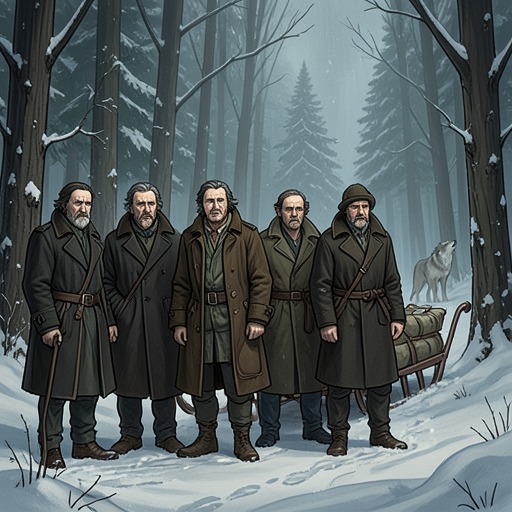
The Call of the WildCharles is a middle-aged man from the States who enters the Northland as one of the owners of Buck and the exhausted sled-dog team. His light-colored appearance, watery eyes, and fiercely twisted mustache suggest a surface of force that the narrative repeatedly undercuts with weakness, disorder, and helplessness. He travels with Hal, his young brother-in-law, and Mercedes, his wife, forming a family party whose confidence is far greater than its knowledge of Arctic travel.
Identity and Introduction
Charles and his companions buy Buck and the other dogs after the team has covered twelve hundred miles with only two days of rest. They acquire the animals, harness and all, for very little money, treating a living transport system as a cheap replacement for dogs judged worthless for the trail. Charles is therefore introduced not as a seasoned traveler but as an outsider entering an environment whose demands he does not understand. His arrival marks the end of Buck’s disciplined service under Perrault and Francois and the beginning of a journey governed by amateur calculation rather than experience.
The new camp immediately reveals Charles’s character. The tent is badly stretched, the dishes are unwashed, and the equipment lies in confusion. While the family tries to load the sled, Charles participates in an effort full of exertion but lacking method. The tent becomes an awkward bundle three times larger than it should be; the clothes-sack is repeatedly shifted from front to back; and articles are unloaded whenever Mercedes discovers something else that must be packed. Charles’s practical authority is visible, but it is not supported by competence.
Incompetence on the Trail
Charles responds defensively when onlookers question the overloaded sled. When one man remarks that the load seems top-heavy, Charles turns away and tightens the lashings as well as he can, though the result is explicitly unsuccessful. His resistance to advice is part of the family’s larger failure: the travelers have observed other sleds but have not learned the principles that make those journeys possible. They calculate the expedition with pencil arithmetic—so much food for one dog, so many dogs for so many days—without understanding that one sled cannot carry enough provisions for fourteen dogs.
The departure exposes the consequences. The team cannot move the frozen sled until Hal follows an onlooker’s instructions and breaks the runners free. Under the rain of blows, the dogs drag the unwieldy load up the street; when the path turns and slopes steeply, the top-heavy sled overturns and spills half its contents. Charles is among those who listen unwillingly as citizens explain that the expedition needs half the load and twice the dogs. The family then removes superfluous goods, including excessive canned provisions, blankets, dishes, and parts of the tent, while Mercedes cries over the discarded belongings. Even after this reduction, the outfit remains dangerously large.
The enlarged team of fourteen is itself a sign of Charles’s mistaken logic. Six newly purchased Outside dogs join the original team, Teek, and Koona, but the newcomers are mostly bewildered, spirit-broken, or unable to work effectively in trace and trail. At the same time, the older dogs are worn out by twenty-five hundred miles of continuous travel. Charles and Hal remain cheerful and proud because fourteen dogs make the sled appear impressive, yet the pride is detached from the material conditions of the journey. Their confidence cannot make the dogs stronger, lengthen the working day, or produce food that the sled cannot carry.
Charles also fails to organize his own labor. Camp takes half the night to pitch and half the morning to break, while poor loading forces repeated stops and rearrangements. Some days the party travels less than ten miles; on other days it cannot start at all; on no day does it reach more than half the distance assumed in the food calculations. The shortfall leads to reduced rations, and the reduction accelerates the animals’ collapse. Charles’s incompetence is thus not a harmless comic flaw: it becomes a chain of operational errors in which bad planning produces exhaustion, exhaustion produces hunger, and hunger makes further travel still less possible.
Family Conflict and the Erosion of Responsibility
Charles’s relationship with Hal is dominated by quarrels over work. Each believes that he is doing more than his share, and each voices that belief whenever an opportunity arises. An argument over chopping a few sticks can expand into disputes involving relatives, distant family grievances, political prejudices, and opinions about art and society plays. While the quarrel grows, the fire remains unbuilt, the camp half-pitched, and the dogs unfed. Charles’s household therefore carries its domestic disorder directly into the wilderness.
Mercedes’s presence intensifies this disorder. She is Charles’s wife and Hal’s sister, and she continually intervenes with advice and remonstrance. Her insistence on riding in the sled adds one hundred and twenty pounds to a load already dragged by weak and starving dogs. Charles and Hal repeatedly beg her to walk, but their appeals fail; once, after she is removed by force, she sits down on the trail, compelling them to unload the sled, travel three miles, return, and put her back aboard. Charles is both participant in and victim of this family structure. He does not establish an effective authority capable of protecting the animals or coordinating the expedition, and the family’s emotional conflicts consume the attention that survival requires.
As the journey strips away the amenities of the Southland, Charles’s conduct becomes harder rather than wiser. The Arctic loses its glamour for the three travelers, but suffering does not give them the patience that the trail can teach to people who work hard and remain kind. Their muscles, bones, and hearts ache, and hard words become the first words of morning and the last of night. Charles’s failure is therefore moral as well as technical: pain narrows his concern instead of enlarging his understanding of the dogs’ condition.
Collapse at White River
The consequences accumulate in the deaths and disabling of the team. Dub’s untreated shoulder worsens until Hal shoots him; the Outside dogs die on inadequate husky rations; and Billee is killed with an axe when he falls and cannot rise. By the time the party reaches John Thornton’s camp at the mouth of the White River, only Joe, Pike, Solleks, Teek, and Buck remain, all in varying degrees of weakness. The dogs collapse at the halt as though struck dead, while Charles sits slowly and painfully on a log, his stiffness showing the physical cost of the expedition.
Charles says little during the encounter with John Thornton. He watches while Mercedes screams and Hal handles the confrontation, and when Hal is thrown backward after striking Buck, Charles merely looks on wistfully without rising because of his stiffness. His passivity contrasts with Thornton’s immediate intervention. Thornton places himself between Buck and further violence, cuts the traces, and examines the dog’s bruised, starved body; Charles neither protects Buck nor meaningfully challenges Hal’s decision to continue.
After the party leaves, Charles stumbles behind the sled while Hal guides it and Mercedes rides. Buck and Thornton watch the procession crawl across the weakening ice. Charles turns only one step toward the others when the sled’s rear drops and the ice begins to give way; then a whole section collapses, and the dogs and humans disappear into the opening. His fate is bound to the expedition’s accumulated failures: overloading, hunger, exhaustion, refusal of warnings, and reckless continuation across rotten ice. The destruction confirms Thornton’s judgment that only fools, aided by the blind luck of fools, could have reached White River.
Narrative Significance
Charles represents a form of frontier masculinity based on ownership, assertion, and endurance without the knowledge or discipline that make those qualities useful. He arrives with Hal and Mercedes expecting that possession of dogs, equipment, and determination will be enough. Yet the Northland measures authority through practical competence: reading ice, organizing labor, protecting working animals, carrying appropriate supplies, and accepting necessary limits. Charles possesses none of these capacities in sufficient degree.
His story also exposes the difference between price and value. The dogs are bought cheaply after their government service, but their exhaustion carries consequences no bargain can erase. Charles’s family treats the team as an expandable resource, adds animals to make the expedition look impressive, reduces food when the arithmetic fails, and continues after the dogs have become incapable of safe work. The final collapse turns that logic against its human owners. Charles’s disappearance is not an isolated accident but the terminal consequence of a system that mistakes bodies for equipment and confidence for knowledge.